Two articles on successive days in the Herald about women's fertility. Both written by women.
The first article said the best age to have children is 25. The second article said women are doing a bad thing putting off having children in hopes that science/medicine will help them to conceive when they are ready at, say, 40.
According to the second item, women shouldn't put off having their children because at 40 you don't have the stamina for bringing up children. Try telling that to all the grandparents in their 60s and 70s who are currently bringing up or helping to bring up their grandchildren.
So let's get a few things clear from the point of view of the wimmin. Never mind what society or the press thinks. It's not society's business when or if a woman has children. Certainly not when we make it so difficult for people to take that step. 'Society' and the Herald can butt out, unless we're prepared to offer help.
Having children at 25 assumes you are in a steady relationship, that you have a partner, someone you can rely on for emotional support - and probably financial support too because it's unlikely that you will have the money to stride out on your own at that age. And don't we just hate young women with a squad of kids who rely on the state for support? Most families now need two wages coming in. (We also know how much families - usually the woman and the kids - suffer financially if a marriage or a relationship breaks down).
At 25 a lot of women are just finishing their education and starting a career. Careers take time to build. Nobody ever said to a woman: Just you relax. It's not an either-or. We will judge you by a totally different set of career rules from the men. We value your role as a mother. You just take a few years off to have your kids and spend a bit of time with them. We'll keep your job open - oh, and yes, we'll pay you to take the time off and your career won't suffer for missing some years.
So women more and more have to wait to have their children. They're not career-driven harpies. They're realists.
For many women, life as a mother is a long balancing act: It starts with: Can I afford to get pregnant? I've discovered as a great-auntie that the full cot or buggy - sorry, 'transport system' - means we're talking big money. Babies are dear little things. How much time can I afford to take off work after the birth? For a start, you have to be in a job for some time before you are entitled to maternity and paternity leave. And the money isn't great. And it runs out pretty fast. What back-up do I have if my child is ill or during school holidays? Pretty crucial, because if you're 25, there's every chance the older generation who could look after your kids is still working. If you're 40, there's a good chance your family 'support' system will be too ill or too sick to help out.
In both cases, your family may be in another part of the country or the world. And childcare is still cripplingly expensive.
Nothing in either of these articles - or anywhere else I've been reading - suggests a solution to the problems women face when planning their families. So older women will go on looking for support to have children. Yes, women looking for fertility treatment will need to access the NHS. It costs. But women at 40 have been paying into National Insurance and the tax system for a long time. They are usually pretty healthy - it's old people like me who cost the NHS - so why shouldn't they get in vitro or other help with their fertility?
The one thing society can and must decide is this. What kind of mothers do we want our children to have? Young ones or good ones whatever their age?
We need to decide how to tackle this. And scolding women is just not going to do it.
Tuesday, 14 June 2016

Friday, 10 June 2016
Abroad is bloody...
When I was a teacher - a long time ago - I was often asked to do things that were not part of my job. If help was needed, I never refused. That was the case for many foreign languages teachers although I would have to say that not many employers valued what their translators did.
So I translated the words of 'Taps' for a girl guide into French, with not the faintest idea what it was about (because I'd never been a guide) and didn't complain when the child who asked me to do it said this wasn't what her guide leader (if that's what they're called) wanted. She wanted a professional translation with rhymes and so on, and that wasn't what I could offer.
I phoned a hospital in Marseille where a friend's daughter was laid up, having fallen down a hole in the road coming out of a nightclub (no comment from me on her sobriety) and was able to talk to the duty staff nurse about her broken pelvis (she was a lot more willing to comment on the patient's state of sobriety) and was able to arrange for her to be brought home.
More terribly, I translated documents and newspaper articles from France, Germany and Spain relating to the deaths of young people I had taught. On one occasion, the parents of the dead boy sat in my livingroom while upstairs I typed a translation of his death certificate and details of the arrangements for his body to be brought home to Scotland. I doubt if I've ever experienced anything more harrowing. Because there is nothing more harrowing than parents burying a child.
I don't take it well when people devalue the work of the translator. I'm shocked to read that only a third of the MSPs in the Scottish Parliament speak a foreign language. Does that mean when MSPs meet Chinese delegates who want to set up links with Scotland, they have to employ translators? Have they any idea how much will be missed if they have to rely on translators? Or the Scotch whisky lobby can't talk to their biggest market: the EU? Except, of course, I know they can, if only because the lead in that market is Donald MacKenzie (ex-Islay High School and now resident in France as our Whisky Ambassador).
Whatever the outcome of this fiasco called the EU referendum, Scotland needs to take a look at what we consider important in trade terms. I once spent a long couple of days with a high heid yin from Ciby-Geigy who told me he never bothered trying to recruit Scottish people who spoke the European languages he needed. He just brought in native speakers of French, German and Spanish. I asked how he knew these people were providing him with correct translations. He didn't.
O, how easy it is to fool people.
Wednesday, 8 June 2016
BHS
Take a look. Just take a look. These are the main players in the BHS fiasco.


Mike Ashley, who wanted to buy BHS. Has spent some time this week explaining to a Westminster committee how he broke the law by paying employees less than the minimum wage.
Chancers, every one of them. Not one of them will end up in court over this or anything else. The only people who will suffer will be BHS employees and retirees. Unless, of course, the great British public steps in and cover the losses the BHS pension and redundancy funds have suffered.
The next time you're asked what provision you've made for your old age, just say you've done your best but you're at the mercy of bastards like this.
Yes, I know most business people are decent and honest and do their best by their employees. But unless they and government step up, people like this lot are going to reduce us all to beggary.

Philip Green - knighted by Tony Blair. Managed to get a whole lot of money out of BHS before it was declared insolvent.

Dominic Chappell, no experience in the retail business. Bought BHS for a pound from Green, but managed to get money out of it even while it was insolvent.

Chancers, every one of them. Not one of them will end up in court over this or anything else. The only people who will suffer will be BHS employees and retirees. Unless, of course, the great British public steps in and cover the losses the BHS pension and redundancy funds have suffered.
The next time you're asked what provision you've made for your old age, just say you've done your best but you're at the mercy of bastards like this.
Yes, I know most business people are decent and honest and do their best by their employees. But unless they and government step up, people like this lot are going to reduce us all to beggary.
Monday, 6 June 2016
Hello, sunshine!
It's going to rain on Tuesday. Windy Wilson, the (amateur) weather guru, says so. There may even be thunder and lightning. I know some of my friends are freaked out by thunderstorms. Myself, I love them as long as I'm indoors, not under a tree.

Windy forecast the good 'spell' we're currently enjoying. To my delight, he bases all his forecasts and his maps (coloured in with his wee boy's felt pens) on what the weather will be like where he lives in Auchterarder. The BBC online forecast can't even stretch to telling us what the temperature is in the West of Scotland, as if Edinburgh and Glasgow were subject to the same weather systems. Windy also has a (nearly) friendly bit of rivalry going with Sean Batty on STV. I think in terms of accuracy, Windy is winning.
Windy is forecasting even more good weather when the Spanish Plume hits Scotland this weekend.

I think we'll cope. A friend has asked on Facebook if it's wrong to superglue a small child's hat to her head to stop her pulling it off in the sun. Several friends are sporting rid-raw sunburn, having forgotten to buy in sunblock and discovered that the stuff they bought in Boots two years ago for that holiday in Ibiza doesn't work any more. And the gingers are unhappy, as are the hay fever sufferers (including me).
I don't want to rain on anyone's parade (pun intended), but this good spell is not unusual in Scotland. This is a moderate country weather-wise: not too hot, not too cold, pretty rainy. Floods, storms that stop the boats sailing in the west and knee-deep snow are all, like pestilence and plagues of frogs, fairly unusual here. We've had a run of pretty bad weather in the last few years but May and June are usually pretty good. It's only when the weans get their summer holidays in July and August that it all goes to hell in a handcart. Going back to school mid-August might be seen as a blessing by some. At least it lets your feet dry out.
My working life used to involve persuading foreign language assistants and visiting teachers that their entire time in Scotland wasn't going to be spent holding an umbrella. I always asked them if they liked our scenery. O yes, lovely. So green, so fertile. (They all went to Skye. Why they always went to Skye I don't know, when there are much nicer islands closer to hand. Islay, Colonsay, Mull...) It's the rain, I would say. That's why Scotland is so green. Rain is the price we pay for living in the most beautiful country in the world.
So here's to summer. Our gardeners at Walton Court are out in force planting up tubs and pots. As soon as I get rid of TBV (see previous post), I'll be out there with them.
Sunday, 5 June 2016
TBV
I'm now referring to what ails me as TBV - This Bloody Virus - as in 'Will TBV ever go away?' and 'I'm sick of TBV!' I got up on Saturday after a day of alternately sweating buckets and shivering with cold and suddenly thought: 'I'll have a smoothie and watch the TV news. It's been a while since I checked what was happening in the world.'
I've long since given up on BBC news programmes. For a wee while I was watching the BBC lunchtime news while waiting for Doctors to come on (it's my only soap - don't begrudge me it) but the formula of something scary about health for the pensioners, something about education to worry the stay-at-home mums and a wee funny story to round things off was pretty boring and not really all that informative. Now I watch C4 news and occasionally ITN news.
ITN news at teatime on Saturday started with a tribute to Muhammad Ali. Fair enough. I got up at one point and put a washing on. When I came back, the presenter was still talking about Muhammad Ali. I went to the kitchen to put papers in the recycling bin and it was still Muhammad Ali she was talking about when I came back. Finally, I realised the entire 15 minutes was going to be about Muhammad Ali. Nothing about floods and lightning strikes across central and western Europe. Nothing about alleged Conservative election fraud in England. Nothing about civil unrest in France. Nothing about Trump (which is, incidentally, the word my nephew is teaching his weans to use when they fart). Nothing about the EU. Not that I missed that one - I've got a postal vote and I've used it, so no scare story can reach me now.
I think my previous blog post has made it clear that I thought Muhammad Ali was a working class hero, but does he really merit having an entire ITN news programme (headlined, you'll remember, 'national and international news') devoted to him?
It got me thinking about the change there has been in TV news recently. There was a time when newscasters delivered the news. It was a factual display of events round the world prepared by an editor (with a journalistic background, I imagine) and read out by a person behind a desk onscreen. We knew what the editor thought was important by what was left out. But there didn't seem to be much spin in individual items. There would be reports and video from other parts of the world by local correspondents, again fairly based on fact.
ITN seems to have gone over to what I can only call 'Tom Bradby's view of the news.' All the people who used to present the 10pm news on ITV have gone - most of them women - and although they are not jobless, they tend to appear now for the weekend, early morning and late night shifts. The number of topics dealt with in a programme is now much smaller and I notice 'correspondents' are usually interviewed in the studio opposite Bradby, so even less chance these days of getting journalists out of the studio, out of London and out of the UK to deal with issues in the rest of Europe, not to mention the world.
As I said, I don't watch BBC but I understand that Laura Kuenssberg has been getting pelters from both sides over her presentation of the EU referendum. I had a look at a couple of her presentations on BBC iplayer. She's playing the same game as Tom Bradby.
I'm not sure either of them is qualified to do this - or entitled to do this.
I'm also not sure it's a good idea for BBC and ITN news to parade members of the public onscreen spouting stuff that is factually inaccurate without at some point correcting them. But then, nobody has corrected the Boris Johnston/Michael Gove lie about 350 million quid a week going to the EU.
So now I'm reduced to watching C4 news, praying that the Tories don't get to privatise the channel and that John Snow doesn't decide to retire. And reminding myself of Humbert Wolfe's wee poem:
You cannot hope
to bribe or twist,
thank God! the
British journalist.
But, seeing what
the man will do
unbribed, there's
no occasion to.
Or maybe TBV and I will just go back to bed and wait for it all to be over.
Saturday, 4 June 2016
Is there an elephant in the room?
The heroes of my parents' generation were footballers, singers, Hollywood actors - and boxers. They idolised Willie Thornton, Billie Holiday, Paul Robeson, John Wayne, Joe Louis and Benny Lynch. I think they'd put Muhammad Ali up there with the greatest.

He was a great boxer and out of the ring a great role model for young men, especially young African-American men, who badly needed heroes in the 60s and 70s. He was courageous in the extreme: it takes great courage to stand up to the might of the US government, as he did when he refused to fight in Vietnam.
The tributes to him today all mention his skill and his nerve. What we don't mention is what he died of. Parkinson's is a horrible condition and Muhammad Ali had it for over 30 years. He may have lived to be 74, but his life was very badly affected long before that.
Over the years, we've come to realise that footballers - especially footballers from the old days when they played with a heavy leather ball - are prone to getting Motor Neuron Disease and that it's probably the result of heading the ball. It's upsetting to see the deterioration in Fernando Ricksen's condition because of MND, especially since he is only 40 and has a young family. There's no proof Muhammad Ali got Parkinson's because of boxing. It has many causes: in a small number of cases it's hereditary, but it's more likely to be caused by a genetic fault or by brain trauma.
What football and boxing have in common is that traditionally they offer success to young men with talent but who are usually born poor.
The difference with boxing is that - as a friend of mine once put it - the purpose of the sport is to disable your opponent.
Thursday, 2 June 2016
London
In the context of the EU referendum, maybe it's time we asked: what's it for?
I've been to London often. My first visit was on a school trip over 50 years ago. As I remember, I thought then it was big (it seemed to take hours to get from the far reaches of the London suburbs to Euston), smelly, noisy and the people seemed to regard visitors as a pain in the arse who got in the way of real Londoners on the tube. Nothing that's happened in the past 50 years has changed my view of the place: it's still somewhere that comes between me and places I really want to be - usually France. Well, France, Belgium, Germany, Holland, Spain - definitely somewhere that isn't London. If I can bypass London I do. In travel terms, it seems the plan of people like Boris Johnson, ex-mayor of London, is to make us all fly via London Heathrow.
The view we're sold is that London brings a lot of money to the UK so we should all be grateful. Except that I don't see the 'trickle-down' theory of finance working: the money that comes to London stays in London.
So it's bit rich to find that one of the main reasons we're given to remain in the EU and to leave the EU is London.
I think of London as a giant bloodsucker. Jobs (good jobs in trade, finance and banking) are kept there, when they could in the digital age quite easily be dispersed to other areas of the UK. That means people have to be brought in to do these jobs. People who would prefer to be elsewhere have to live in a city that is actually quite hostile to those who work there. These are often young people, and they leave communities in parts of the UK that really need their skills. There aren't nearly enough houses in the London area, so these young people rent or buy houses they can't afford and struggle to pay for them. They always seem to be planning to escape London as soon as they can. Of course, there are poor people in London. They are often people from minority groups, usually foreigners, sometimes unregistered and flying under the radar. The two groups only seem to meet as masters and servants.
This doesn't make for stable communities.
So what to do? Maybe first of all accept that the nature of the modern city may be changing: maybe we don't need to have gazillions of people gathered in one place to keep the city working. In the long term, maybe we need to rethink what the city is for.
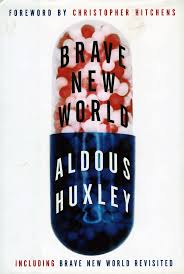
Maybe we need to re-read Brave New World, a much more scary novel than 1984, in order to see what happens if we don't re-think how we live.
Subscribe to:
Posts (Atom)