I thought I'd watch Pointless. Oh no, I can't: the national broadcaster has got Wimbledon on both its main channels for - what? - the next two weeks. Why is that?
Every bloody year it's the same. All winter we get football or rugby. Turn your back on the telly after the 10 o'clock news and there's a good chance they're showing football, with overpaid numpties spouting forth endlessly about teams run by foreign managers and stuffed full of foreign players, so we can't even claim football as the working-class British boys' way to wealth and fame any more. Channel 4 regularly takes off Countdown so we can all watch the racing.
But the summer is the worst: wall to wall tennis, cricket, the Tour de France, formula 1, golf. And if it's a really bad year there will also be more football from the world cup or the endless boredom of the Olympics, relieved only by the excitement of the 100metres if Usain Bolt is competing.
But you like sport, I hear you say. Good for you. I don't. I quite like that Wimbledon gets the weans out in the street with racquets and a ball kidding on they can play for a few weeks, but I am driven demented by grown-ups who imagine watching tennis somehow makes them experts on the game - or that they miraculously get fitter and healthier by vegging out on the settee, drinking beer and eating crisps. At least, people who go and watch the golf at the course get exercise from walking about after the golfers.
Luckily, I have other things to watch on my telly: a backlog of series that I've been saving just for the summer. And I've got a decent supply of books. And an online course on the Great Extinctions in earth's history - week 3 of 5 just completed and I'm on the look-out for another course to do already. And movies coming from Lovefilm or downloadable from the iplayer or Netflix.
And given the state of the summer weather, it looks like I'll need all of these to survive till September.
Tuesday, 4 July 2017

Sunday, 2 July 2017
A light bulb moment
Does anybody else think we're getting ripped off something rotten over light bulbs?
There I was, having (another) fairly peaceful night of insomnia and the light went out. That's the third bulb to go in the same lamp in a couple of months: halogen, E27, warm white, 19W, 219 lumen - whatever that means. From B&Q. They're not cheap, these bulbs. They're supposed to be 'dimmable.' So why don't they last? I'll have to buy more soon because that was my last one, but what do I buy? And where?
I had a quick look at websites and they offer bulbs that are 5W. What does that mean when you switch them on? Can I read by that?
In the past, I had 2 kinds of light bulb: 60W and 100W.
Now every light is different. In the kitchen and bathroom I've got wee globe things, but they're different from the ones in the hall and my bedroom and they in turn are different from the ones in the livingroom. Some are LED and are halogen. Sometimes I have to buy bulbs I used to put into overhead projectors at school, and that need me to get my brother (the family electrics expert) to come and change, holding the dinky wee things covered in a paper hankie.
Let me tell you this: I didn't retire to do this kind of sh*t*! If you have an answer to this problem, post it on Facebook - please!
Saturday, 1 July 2017
The D word
The D word I mean is disability.
No, don't go! Have a wee listen to this podcast from the BBC. It's called Ouch and it's about disabled people. I hope they change the name soon, but the podcast is good. It's about Jared O'Mara, the MP for Sheffield Hallam, who has cerebral palsy.
http://www.bbc.co.uk/news/av/disability-40462699/the-only-mp-who-wears-a-t-shirt-in-parliament

If you heard an announcement on the news recently that MPs no longer have to wear ties and wondered why, it's Jared: he raised the issue with John Bercow and got full cooperation. He can't do up shirt buttons - or put on a tie, I imagine - so the dress rules of the House of Commons have been changed.
He's still left with other problems: the door he should use to get into Portcullis House needs two hands to open it, so he's having to come in the back door. There are going to be other problems but he has the support of the Speaker and of David Blunkett, also a Sheffield MP, who has been there before him.
Jared, of course, is trying to lead a normal life, so he hasn't got a big sign over his head that reads: Cerebral Palsy! Disabled! In the podcast, he mentions two things I find interesting:
Disability law expects employers to be 'anticipatory,' that is, to work out what will be needed for disabled people to play a full role in working life. And yet, the House of Commons, which passed the law in England, had nothing in place for a disabled MP: no one on the admin staff nominated as the point of contact for him on arrival; no procedures in place to make his induction easier; and no information in place to help staff in the House to work with him.
That brings me on to: education. It looks as if the mental health programmes put in place on TV and in the press over the last couple of years have got people used to the idea that many of us will experience a mental health problem in our lives and that men especially need to be more forthcoming about their mental health issues.
Do we have the same sensitisation programmes in place to deal with disability? Blindness and Down's are easy to recognise but do we know how to recognise autism, cerebral palsy, deafness? And if we recognise all of these, do we have a basic understanding of what to do and how to help? Notice I'm not suggesting schools should do this: the mental health campaign only took off when we stopped telling schools they had to do it and we - the grown-ups - started doing it ourselves.
As a volunteer, I've seen so many disabled people in nice accommodation with security systems in place, but stuck at the top of a block of flats with no lift, so effectively trapped indoors. Or even in blocks of flats with a lift, trapped by the weight of the fire doors which they can't open. The whole of the UK is alive with visiting 'carers': they're out there every day from early morning to bedtime; they rush around from client to client, underpaid and overworked; and some of what they do, I'm convinced, could be better done by the disabled clients themselves if they had the right kind of accommodation, inhouse cleaners, food preparers, and transport.
I heard a report on C4 news last night about housing: either we frontload the cost of housing by subsidising council house building (a one-off) or we endload it by giving private landlords a whopping subsidy (a continuing drain on the economy). The UK at present does the second version and it's costing us a mint. Property owners are doing fine though.
Support for disabled people is much the same: we can invest in suitable housing and make all buildings, pavements and facilities disability-friendly (a one-off), or we can spend money on carers because at present disabled people can't go out on their own or manage their homes or cook (a constant spend).
It used to be called joined-up thinking in the public services. But I gather there's no money in that: entrepreneurs these days like to hoover up the results of chaos in the public services.
Meanwhile I'm away to get a stick to use on those days when my energy is rock-bottom and my walking is kind of shaky. I know I'm not mobile enough to cope with crowds any more, as I found out at Glasgow University last week. I know how to behave in crowds but I can't cope with people who suddenly change direction and walk in front of me or elbow me as if I'm not there (thanks for that, people). I can't manoeuvre the way I need to in a crowd and I get kinda panicky when people jostle me. I'm grateful to my lovely family, without whom I would not have been able to manage the steps inside the university or at the Lorne Hotel or The Sisters restaurant.
But my concerns are as nothing compared to most disabled people's. I just wish I could see an end to the persecution (strong word - but I've thought it over and it's right) and exclusion of the disabled.
Friday, 30 June 2017
The Grammar Nazi Is In!
If the conditions you set for your argument are plural, they can be called criteria. If you only have one condition, it's the criterion.
There is no expression in English (whether in the UK or anywhere else) that starts would of. The phrase would have is part of the conditional perfect tense, which only boring old gits like me know, and using it adds a certain elegance to your English.
The pluperfect tense is threatened these days. Myself, I would employ someone who knew it was perfectly okay to say he had been ill, even though most Americans seem to have given up on it while ironically keeping the expression I would have gone if I knew. That just sent a shiver up my spine. If you've learned Latin, it's called the sequence of tenses. But it's really all about making your meaning clear.
If you mean also or excessively the word to use is too. Otherwise it's to. He's rich too is fine, as is he's too rich, though frankly I don't know many people in either category myself these days.
The plural of a word ending in -y is -ies. Thus one bastard Tory is spelled like this. But several are spelled bastard Tories. May you always live in a place where there are none of these creatures. Notice there are no apostrophes anywhere. Plurals don't need apostrophes, just -s or -es.
There is such a thing as a plural verb: so his anger is understandable is fine but you need to write his anger and disappointment are understandable.
The words may and might are different, although no one seems to know that now. So you may have told me and you might have told me are quite different phrases. You may have told me means there's a possibility you told me, while you might have told me means something else entirely., usually something starting FFS...
Not that any of this means a damned thing. I would settle for people reading what they put up on the screen before they click enter so we don't get mat/mate/men instead of me and so that/than/then and the are not interchangeable. Or am I the only person whose eye stops on these mistakes and loses a bit of the message? And isn't this what technology is about? Communication? The least we can do is make sure we are trying to get the message over.
That said, I'm now going back to re-read this blog entry just in case...
Wednesday, 28 June 2017
Gaudeamus
My nephew Craig graduated from Glasgow University today. French and Spanish, since you ask. (Nothing to do with me, honest).
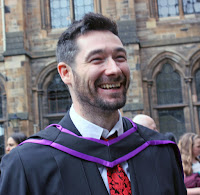

He's not the first in our family to graduate from Glasgow (a university in the world's top 100, as the depute principal reminded us in his closing address). I did and so did his big brother.
It was a great day. Craig seemed to be busy at the university most of the day, with a rehearsal of the ceremony, getting his photo taken, picking up his gown, and afterwards going for a 'free' buck's fizz in the cloisters. (I expect someone will tell me why these are not cloisters at all but what the hey). His parents were at the university for the afternoon and the rest of us joined him later. He'd managed to get tickets for 5 of us, so his brother and his proud aunties were able to see the ceremony too. Bute Hall as always was a fabulous setting. I'm sorry to say my sister and Craig's auntie Linda let the side down by rising to their feet and cheering roundly when he got capped. But the university was keen for people to participate, so they did. The organist was the star of the show: telling the audience how to pronounce the words of Gaudeamus igitur and then giving us Queen's Bohemian Rhapsody as the exit music. Brilliant choice. Sent us all off with a laugh and a spring in our step.
I'm not putting this up to boast (well, okay, I am) but I really want to ask people who graduated along with me in 1973 - Margaret Ross, Anne Wheeldon, Elspeth Crocker, Rosemary Meechan, Jenne Gray - do you remember any of our graduation? I seem to have developed amnesia over it. I can't remember anything being organised by the university. Was there a rehearsal? I remember I had to get my own gown and hood and I arranged my own photo later. There was no video. Definitely no photos posted on the website or a Facebook page. No personalised hoodie available to buy in the cloisters. No copies of the day's Herald for sale. My aunt and uncle got extra tickets for themselves because my uncle knew the then registrar of the university. They drove my parents and me to Loch Lomond for my graduation lunch. And that was it.
I think I like the new version. But I was a bit taken aback first at the cost of all the things attached to graduation, and secondly at how many graduates were unable to attend. Is this a money thing? Even Craig, with his suspicion of events like this (we've trained you well, Grasshopper), found this occasion uplifting. It would terrible to think that people who manage to make it through university can't afford to graduate with all the pomp due to them. Is there a charity that helps students in this situation? I'm off to find out.
Monday, 26 June 2017
It's history, man
I watched two TV programmes tonight: one was about the murder in Glasgow of three policemen by an ex-policeman. It appeared on Alba and was half in Gaelic and half in English. The other was a wee gem in the STV series The People's History Show, all about Scotland's relationship with slavery and the emancipation of slaves.
Let's talk about the Alba programme: in December 1969, a former police officer was responsible for the death by shooting of two serving policemen and possibly of a thief who had been working with him and is thought to be buried in the foundations of the Kingston Bridge. No one has ever been able to explain why he did it. I was 21 in 1969. I'd just come back from living in France for a year. I remember nothing about this story. The man responsible, Howard Wilson, may still be alive. I can't tell you: there's nothing on the internet about his life after he was released from prison in 2002.
It really bugs me that I have to go to Alba for this kind of information, especially since Alba is already where I go to get information about what's happening in the wider Europe, through the Eorpa series.
In the STV documentary, there was a suggestion that Scotland's relationship with slavery has been kept from us. I was astonished at this. A wee bit of investigation will tell you, it's not just slavery, guys: Scottish history has been kept from Scottish people for a couple of centuries now. We know about David Livingstone, Robert the Bruce, William Wallace, Mary Queen o Scots, Alexander Fleming and John Boyd Orr but as for the history of the poor, of women, of the Gaels and the Irish and others who settled here, not so much.
But ask us about British heroes - and heroines - and we can rhyme them off: Wellington, Nelson, Florence Nightingale, Edith Cavell, etc. We know who Shakespeare was but have never heard of Sir David Lindsay, who was close to being Scotland's Shakespeare. We admire the great English writers of the 18th century like Pope and Dryden but we know less about the Scottish Enlightenment than our French and American compatriots, who gladly acknowledge its importance to their revolutions. We've also managed to ignore most 20th and 21st century Scottish poets while promoting the works of poets from other countries of the UK. So Iain Crichton Smith, Kathleen Jamie and Norman MacCaig are never mentioned. But you know who Philip Larkin is, right?
And our history is all in wee bits, isn't it? We know the Vikings made their mark on a lot of Scotland but have we any idea what the repercussions were for Scottish people, which are still being felt today in terms of identity? We learned about Bonnie Prince Charlie but no one ever joined the dots to show us where his movement fitted in to the geopolitical map of Europe, let alone the world.
The scary thing for me is that I am old: I know quite a lot of our history and I worry that when my generation snuffs it there may not be anyone to take the flame and run with it. And that's how it feels: Scots are on a great quest. I don't want to ignore or wipe out British history but I do want to be sure our children and grandchildren can be educated in what it is to be Scottish. Better than my generation was.
The saying is true, I'm afraid: if you don't know where you came from, you can't know where you're going.
Sunday, 25 June 2017
Sing a long a BBC
I wasn't going to post this because I can see people writing me off as a music snob. And if liking music from medieval church music to Mozart to Nick Cave, then I am.
I don't much like Ed Sheeran and want never to hear Galway Girl ever again, although I wish Ed good luck with his career (which will probably end quite soon and no one will remember a single one of his songs - but never mind, he'll have made a packet by then) but I like Tom Odell and Mariah Carey and I can sometimes enjoy listening to Beyonce, even if her lifestyle just makes me think she's a pain in the a*se. The old gals and guys are fine with me: not Elton or the Stones or the Beatles or Abba (meh), but Queen, Johnny Cash, Yes, Elvis, ELO, Chicago, Nick Drake, the Killers, James Taylor. Are Coldplay and Radiohead old guys? I quite like them. I'm also glad to see Oasis sort of making a comeback and I still have a soft spot for Dire Straits and Dolly Parton.
There was a preview in the National for a new series on BBC called Pitch Battle. (Just a small aside: the correct term is pitched battle). The previewer didn't like choirs and said she couldn't listen beyond a couple of minutes. But I do like choirs and I know a lot of people who are in choirs so I decided to watch.
It's grim. Fronted by either Mel or Sue (I don't know which is which but at least it's not the awful cloying Claudia or Ant and Dec, one of whom is currently in rehab, though I couldn't say which). The opening number had been choreographed by a West End somebody and involved lots of very acrobatic running about while singing. A spokesperson for an a capella group mentioned it was tough to run about and sing at the same time. O, really?
We were introduced to the judges and there - to my horror - was Gareth Malone.
Gareth has fronted quite a few series about choirs. He's in favour of singing, is Gareth. He has got all sorts of people together in workplace choirs, community choirs, gospel choirs, college choirs, refined what they do and put them in the hands of music teachers and sometimes choreographers and what they produced is the best they can possibly be. They must be proud of their performance. They're not West End ready but they are pretty nifty for amateurs. He has spent time with the choirs, got to know their talents, respected their beliefs. Gareth brings out the best in people.
Why isn't Gareth presenting Pitch Perfect? Why is he just a judge? Because this is not about singing. It's a show. It's showbiz. It's about winning back the Saturday night audience for the BBC. It's all noise, funny camera angles and odd comments by the hostess and the judges.
Frankly, it's embarrassing.
This was the BBC's opportunity to encourage community solidarity through music, educate people (it's in the BBC Charter, people) and make entertainment fun. They're never going to be able to compete with ITV and C4 'reality' programmes (not so real to anyone I know) so why does the BBC go on with awful stuff like this?
If you have an answer, don't contact me - I've long since given up trying to discuss anything with the BBC - but feel free to email the BBC. Why not? We pay for them.
Subscribe to:
Posts (Atom)